Hands-on AI implementation · Greenwolf Tech Labs
AI implementation consultants who build it, wire it in and keep it running
Greenwolf Tech Labs is a team of AI implementation consultants that builds working AI inside US businesses: receptionists that pick up the phone, agents that update your CRM, chatbots that answer from your own files, and automations that move data between the tools you already pay for. It is for ops, sales, support and IT leads who already know what they want automated and need a team to build it, connect it to their systems and look after it once it is live.
Quick answer
What does an AI implementation consultant do?
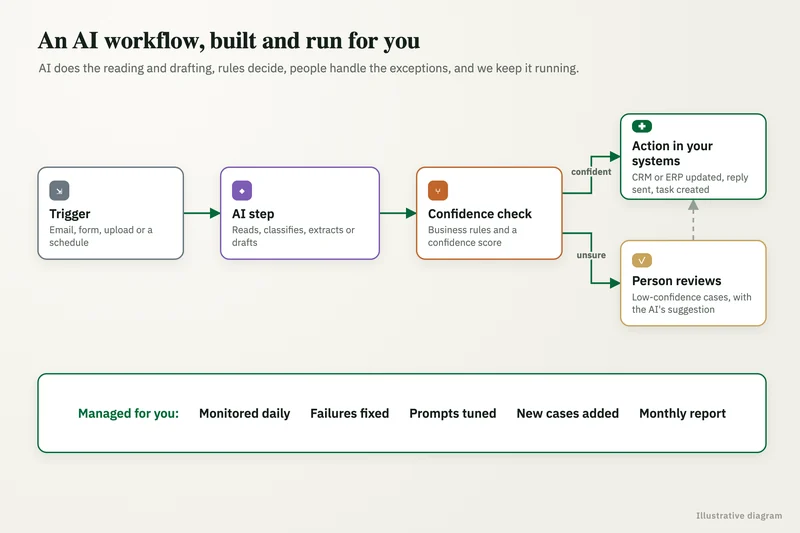
An AI implementation consultant builds and deploys AI systems inside a company's existing tools instead of only advising on them. The work covers choosing the model and platform, connecting it to systems like HubSpot, Salesforce or NetSuite, adding confidence checks and human review, testing against real cases, and keeping it running after launch.
- We build, connect and operate AI systems; a slide deck is never the final deliverable.
- Every build plugs into your CRM, ERP, inbox, phone line or document store.
- Low-confidence outputs land in a human review queue before they reach money or customers.
- Fixed price after a free review, and you keep the accounts, code, prompts and data.
Platforms and systems we work with
Services
What we do
Every engagement is scoped after a free review and delivered at a fixed price.
AI implementation services
End-to-end delivery of one scoped AI workflow, from data access and build to testing, launch and tuning.
Learn more02AI integration services
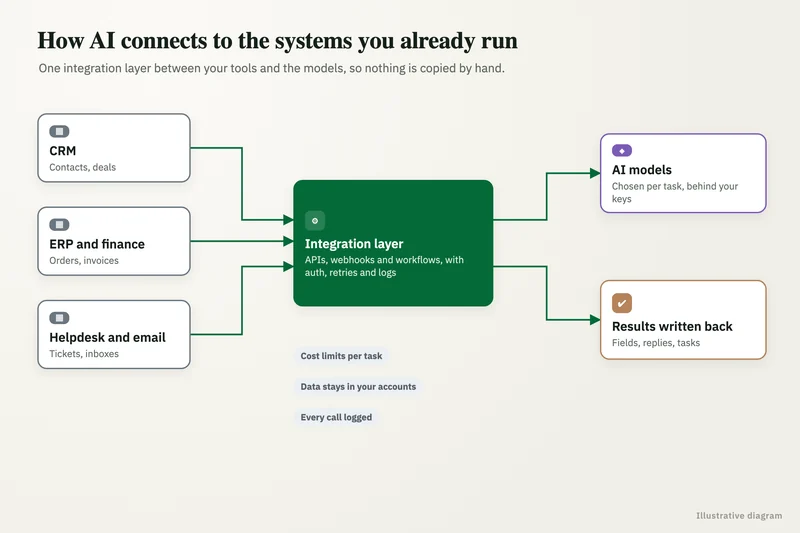
Connecting models to Salesforce, HubSpot, NetSuite, QuickBooks, SharePoint and other systems with permissioned read and write access.
Learn more03AI receptionist
An inbound phone assistant that answers, books appointments, routes callers and hands over to staff.
Learn more04AI voice agents
Outbound and operational calls for confirmations, follow-ups, surveys and reminders, with consent checks built in.
Learn more05AI agents
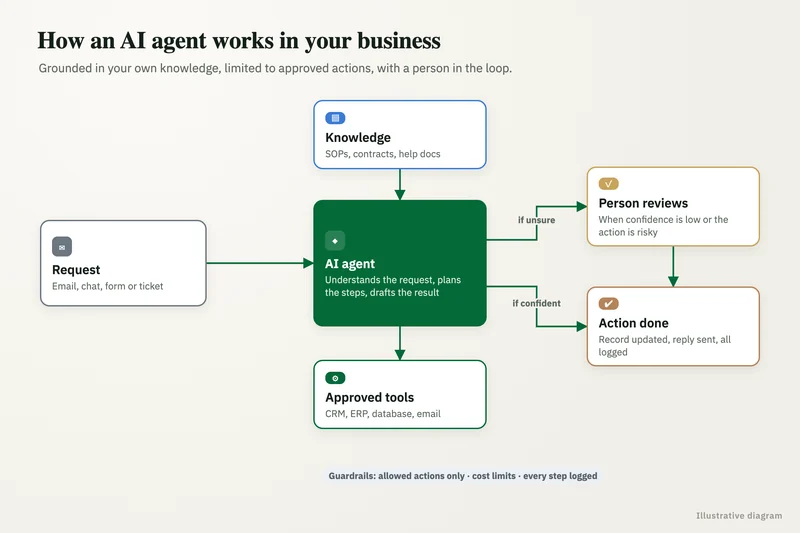
Multi-step agents that take actions in business systems under tool limits, approvals and logging.
Learn more06AI chatbot
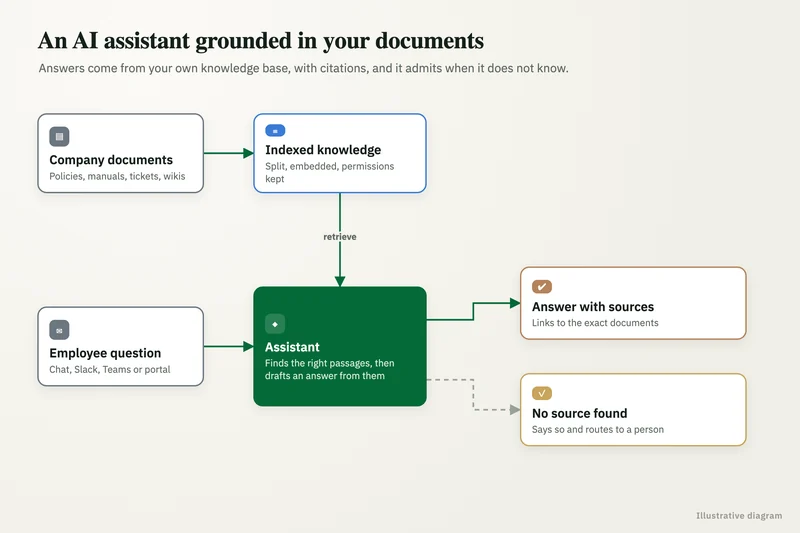
An assistant that answers from your own documents with citations, on your website, Slack or Teams.
Learn more07Document processing
Extraction of fields from invoices, forms and contracts into your ERP or CRM, with review queues.
Learn more08Supplier identification
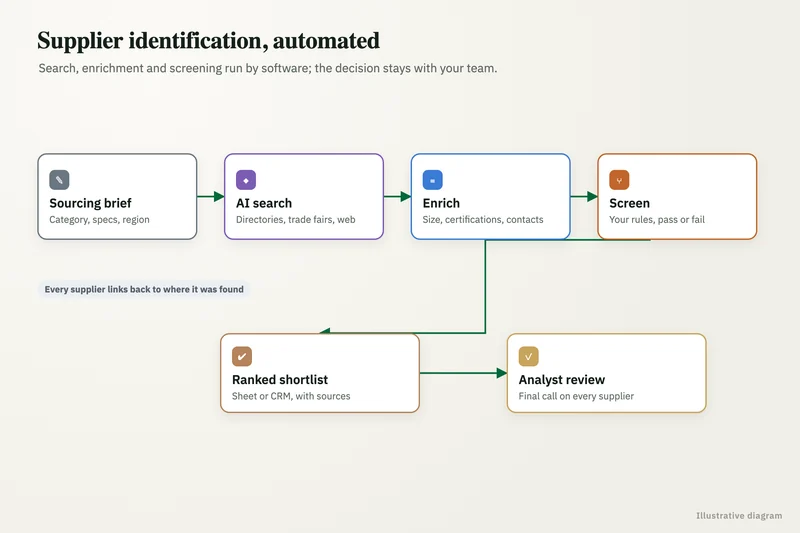
Automated research that finds candidate suppliers and applies your screening rules.
Learn more09Data enrichment
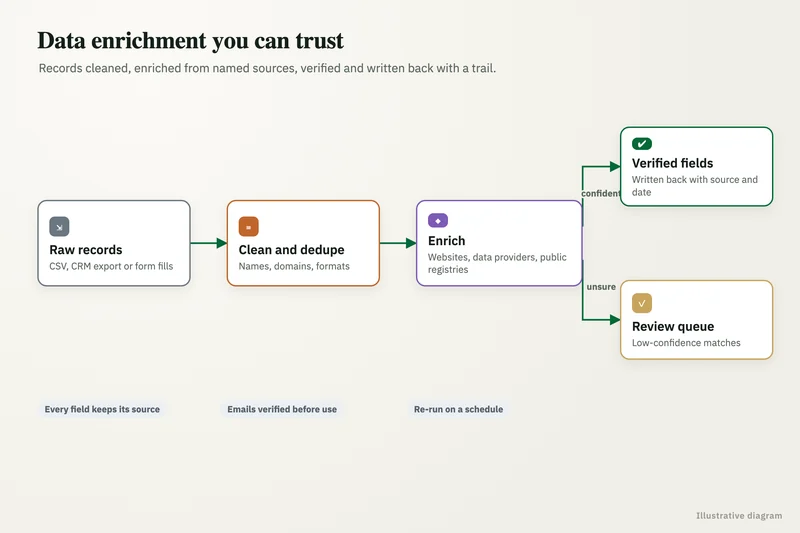
Filling gaps in company and contact records using sources such as Clay and Apollo.
Learn more10AI video generation
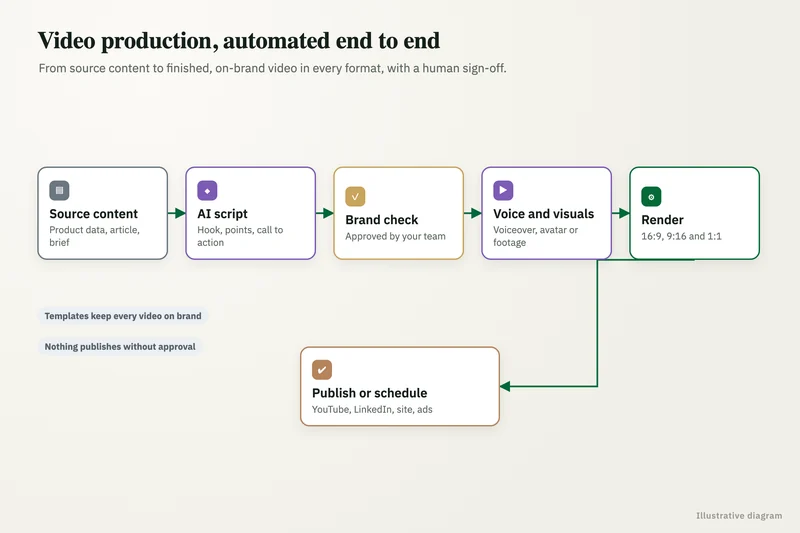
Templated video produced automatically from scripts and data for training, sales or product content.
Learn more11Workflow automation
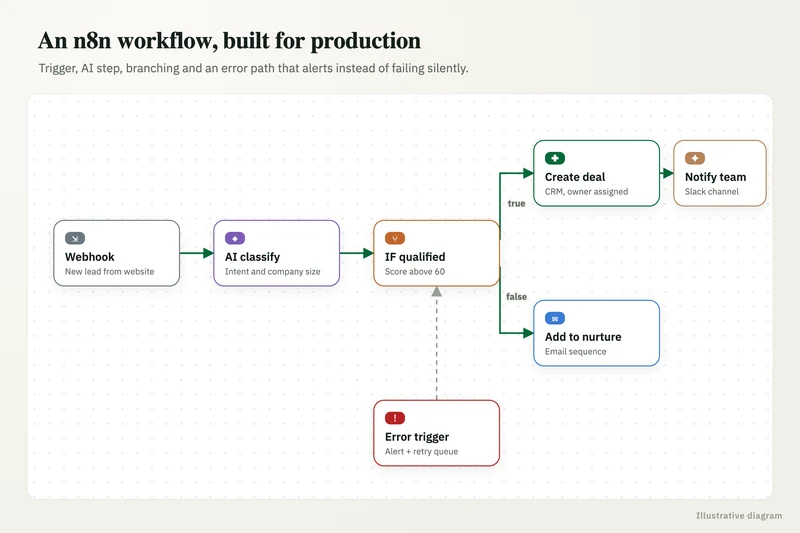
Process automation in n8n, Make, Zapier, Apps Script or Python, with AI steps where they help.
Learn more12AI lead generation
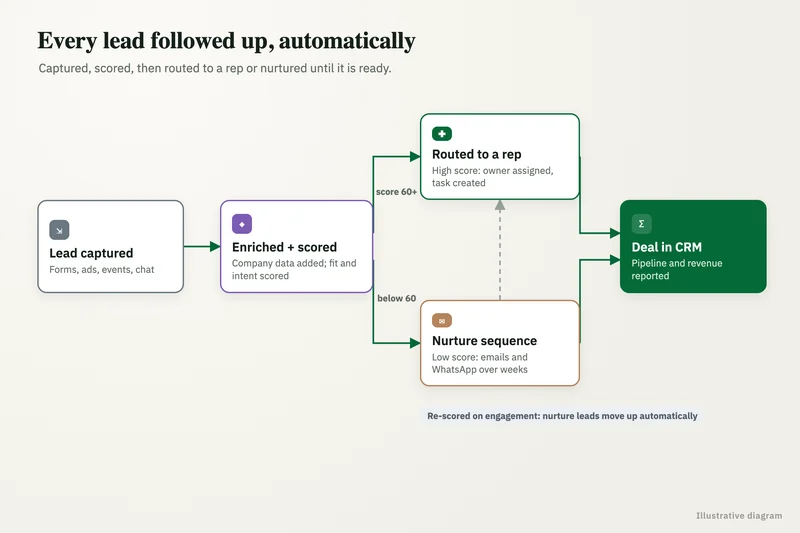
Lead capture, scoring and follow-up sequences that feed qualified prospects into your CRM.
Learn more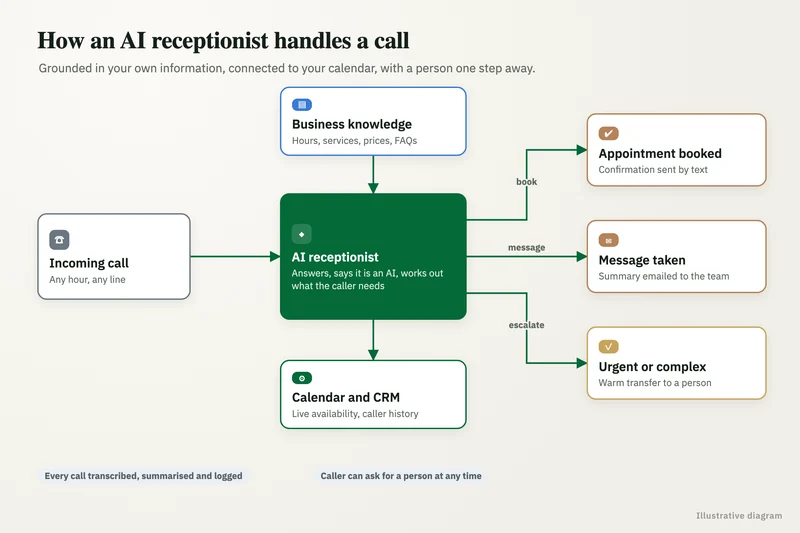
Case study · Procurement firm, nuclear engineering, Europe
Supplier intelligence tool
Supplier details lived in many Excel files, and every evaluation meant hours of manual research. A central supplier database with automated research, side-by-side comparison and filterable profiles.
- About 30 hours a month saved
- Reports in under 15 minutes instead of 4-5 hours
Greenwolf Tech Labs in numbers
What does an AI implementation consultant actually do?
An AI implementation consultant turns a known problem into a running system. Where an advisor stops at a recommendation, we write the prompts, build the workflows, connect the APIs, set up the phone numbers and stay on call when something breaks.
A typical week on one of our builds looks like this: mapping which fields in HubSpot or Salesforce the AI is allowed to read and which it may update, writing extraction rules for the PDFs a team receives every day, setting the confidence score below which a person must approve the output, and running a test set of real past cases to see where the system gets it wrong. None of that is glamorous, and all of it decides whether the project survives contact with real customers.
What can we build and connect for you?
We build the AI systems that mid-size teams ask for most often, and we connect each one to the tools where the work already happens. Each service below has its own page with architecture, failure handling and the questions to ask before you start.
- AI receptionists that answer inbound calls, book appointments and transfer to staff.
- Outbound voice agents for confirmations, follow-ups, surveys and payment reminders.
- AI agents that take multi-step actions in your CRM, ERP or ticketing system.
- Chatbots and internal assistants that answer from SharePoint, Google Drive or a help center, with citations.
- Document processing that pulls fields from invoices, forms and contracts into your systems.
- Supplier identification, data enrichment and lead generation pipelines.
- Automated video generation, plus workflow automation in n8n, Make, Zapier, Apps Script or Python.
How is AI implementation different from AI strategy work?
Strategy work decides what to do; implementation makes one chosen thing work every day. If you already know that missed calls, slow invoice entry or unanswered support tickets are costing you, you do not need a six-week assessment. You need someone to scope the build, connect it and measure it.
Our free review is short and practical. We look at the workflow, the systems it touches, the data that feeds it and the people who will check its output. You get a written scope with the architecture, what goes live first, how errors are caught and a fixed price. If we think the idea will not pay back, we say so in that review rather than after you have paid for a build.
Why do so many AI pilots never reach production?
Most pilots stall because they were built as demos, not as parts of a working process. A chatbot that answers well in a meeting fails when it meets stale documents, missing permissions or questions nobody tested.
MIT NANDA reported in its 2025 study of generative AI in business that projects built with specialist partners succeeded about 67% of the time, against about 33% for internal builds. The pattern behind that gap is familiar to us: brittle workflows, tools that do not learn from context, and poor fit with daily work. We design around those three problems from the first call by building inside the tools your team already opens, logging every prompt and output, and keeping a person in the loop where a wrong answer costs money.
Process
How an engagement runs
- 01
Free review
A call to map the workflow, the systems involved and how success will be measured.
- 02
Fixed scope
A written architecture, launch plan, error handling and one fixed price.
- 03
Build and test
We build in your accounts and run the system against a set of real past cases.
- 04
Supervised launch
The system goes live with human review on, while we tune thresholds from real traffic.
- 05
Handover
You receive code, prompts, logs, documentation and an optional support plan.
Which platforms, models and systems do you work with?
We pick the model per task and keep the choice swappable. Depending on cost, data rules and accuracy on your test set, a build may call OpenAI, Claude, Gemini, a model on Amazon Bedrock or Microsoft Foundry, or an open-weight model such as Llama or Mistral running in your own cloud.
On the systems side we regularly connect HubSpot, Salesforce, NetSuite, QuickBooks, Zendesk, SharePoint, Google Drive and Google Sheets. Voice builds run on platforms such as Vapi, Retell AI, ElevenLabs Agents or Bland AI with Twilio numbers. Retrieval uses Pinecone, Qdrant, Supabase with pgvector or Azure AI Search, and orchestration runs in n8n, LangGraph or plain Python, whichever your team can support after handover.
What happens after go-live?
Go-live is the start of the measured phase, not the end of the project. For the first weeks we watch every exception, compare AI output against what reviewers corrected and tune prompts, thresholds and retrieval until the error rate settles.
Each system ships with prompt and output logging, a cost cap per task so a loop cannot run up a model bill, alerts when an integration fails, and a rollback path to the previous prompt or workflow version. The eval set of real cases we built during testing stays with you, so any future model change can be checked against the same examples before it reaches customers.
Who owns the code, prompts and data?
You do. Builds run in accounts you own: your model API keys, your n8n or cloud instance, your Twilio numbers, your vector database. We hand over the code, prompts, workflow exports and documentation, and nothing stops you from running it without us.
That approach comes from eight-plus years of building automation and analytics for over 200 clients. One of our case studies is an Australian insurance brokerage where an automated pipeline now standardizes every insurer's spreadsheet into one dashboard, cutting report time from 4-5 hours to under 5 minutes. The same discipline (clear inputs, checked outputs, a person signing off) carries into every AI build.
How much does AI implementation cost and how long does it take?
We quote one fixed price per scoped build after the free review, so you know the number before anything starts. Running costs (model usage, voice minutes, hosting and platform seats) are paid directly to the vendors on your accounts, and we estimate them in the scope.
Timelines depend on how many systems a build touches and how messy the source data is. A single workflow with one integration moves much faster than a voice agent that books into a scheduling system and writes back to a CRM. For market rates and the factors that move a budget, read our AI implementation cost guide.
The team
The people who do the work
Engineers and analysts with experience from top consulting firms, who build AI into the systems you already run.

Harsh KhubchandaniDirector, Automation and Analytics

Sagar KhubchandaniDirector, Analytics and Finance

Saumya SrivastavaBusiness Intelligence Lead

Dhruv AacharyaData Analyst and Automation Engineer

Avishkar HaseData Analyst

Kanika SharmaMarket Research Lead

Talk directly to the founder
The person behind the practice
Harsh leads Greenwolf Tech Labs' automation, analytics and AI practice. He began in pharmaceutical commercial operations at ZS and has spent 8+ years building automation and reporting for operations-heavy businesses, the kind where an AI mistake shows up in an invoice, a shipment or a patient record. That is why every system we recommend or build has a review path and a log.
You can reach him directly through Greenwolf Tech Labs or LinkedIn.
Featured in The Economic Times, Dynamic Business Leaders of 2024
Connect on LinkedIn
Selected organisations our team has delivered for




 .
.Commitments
What you can hold us to
- Live in weeks, in stagesA working first version early, then hardening. You see real output before the final invoice.
- A fixed price, in writingQuoted after a free review, with monthly running costs estimated up front.
- A person in the loopAnything touching money, customers or regulated data gets a review step and a full log.
- You own everythingBuilt in your accounts with your API keys. Code, prompts, workflows and documentation are yours.
FAQ
Frequently asked questions
How much does it cost to hire an AI implementation consultant?
We give a fixed price per build after a free review rather than billing open-ended hours. The price depends on how many systems the build connects, the volume it handles and the review steps it needs. Our AI implementation cost guide lists third-party market rates for comparison.
Do we need clean data before implementing AI?
Not perfectly clean, but you need to know where the data lives and who can fix it. Many builds include a cleanup or standardization step, and the review will tell you which data problems would block the project and which the AI can work around.
Which AI model do you use, OpenAI, Claude or Gemini?
We choose per task after testing on your own examples, and we keep the model swappable. Cost, accuracy, data residency and whether the vendor offers the enterprise or API terms you need all factor in. Open-weight models in your own cloud are an option when data cannot leave it.
Can you connect AI to our existing CRM or ERP?
Yes. We regularly connect to HubSpot, Salesforce, NetSuite, QuickBooks, Zendesk and Google Workspace through their APIs or through n8n. We agree which fields the AI may read and which it may change before any write access is switched on.
Can the AI run in our own cloud or on-premise?
Often, yes. Orchestration can run on a self-hosted n8n instance or in your AWS or Azure account, and models can be called through Amazon Bedrock or Microsoft Foundry, or run as open-weight models on your infrastructure. The review settles which parts can stay inside your network.
Who maintains the system after launch?
You can run it yourselves with the documentation and eval set we hand over, or keep us on a support plan for monitoring, prompt tuning and integration fixes. Either way, the accounts and code stay in your name.
Do you work with US companies, and in which time zones?
Yes. Greenwolf Tech Labs has offices in India and the USA and works remotely with US clients, holding calls during US business hours. Builds run in your accounts, so where our team sits does not change where your data lives.
Keep reading
Related pages
Get started
Tell us what you want automated
Describe the task, the systems involved and the volume. We reply within one business day with an architecture, the tools we would use, running costs and a fixed-price build plan.
- Free 30-minute build review
- Fixed quote before any work starts
- You own the accounts, code, prompts and data
Prefer email? info@aiimplementationconsultants.com
Get a free build plan
Two lines is enough to start.