

Implementation
AI implementation services that take one workflow all the way to production
Our AI implementation services take a single, clearly defined workflow (intake emails, invoice entry, ticket triage, lead routing) and turn it into a system that runs every day inside your existing tools. They are for operations and IT leads who have picked the process and now need a team to handle data access, the build, testing, launch and the tuning that follows.
Get a free build plan
Two lines is enough. A specialist replies within one business day.
Quick answer
What do AI implementation services include?
AI implementation services include scoping one workflow, getting access to the data and systems it needs, building the AI steps and integrations, testing against real past cases, launching with human review switched on, and tuning prompts and thresholds after launch. A good provider also hands over logs, documentation and the code.
- We implement one workflow at a time, measured against real past cases.
- Every AI step has a confidence threshold and a human review queue behind it.
- Running costs are estimated up front and capped per task in production.
- You receive the code, prompts, workflow exports and eval set at handover.
What do AI implementation services include, step by step?
They cover everything between the decision to automate a process and that process running unattended for most cases. In practice we split the work into six blocks, each with its own sign-off, so you can see progress in working software rather than status reports.
The blocks are scoping, access, build, evaluation, supervised launch and tuning. Scoping fixes the inputs, outputs and the people involved. Access means service accounts and API keys in your name for every system the workflow touches. Build covers prompts, orchestration and integrations. Evaluation runs the system against a set of real past cases. Supervised launch puts it in front of live work with reviewers approving outputs. Tuning lowers the review load as accuracy is proven.
- Inputs and outputs written down field by field, with examples.
- Service accounts and least-privilege API access in your tenant.
- An eval set of real cases with the correct answers recorded.
- A rollback plan for every prompt, model or workflow change.
How do you choose which workflow to implement first?
Pick the process with high volume, a clear right answer and a person already checking the result. Invoice coding, inbound lead routing and support ticket tagging fit that description; open-ended work like writing strategy memos does not.
During the free review we ask four questions about each candidate: how many times a week it happens, how long one instance takes, how you would know the AI got it wrong, and what a mistake costs. Back-office work tends to win on all four. MIT NANDA reported in 2025 that the biggest returns came from back-office automation even though more than half of budgets went to sales and marketing, which matches what we see when buyers bring us their shortlist.
What you get
What we deliver
Scoped and quoted at a fixed price after a free review.
Workflow scope
A written definition of inputs, outputs, review rules and success measures for the chosen process.
Working build
The AI steps, orchestration and integrations running in your accounts, not ours.
Eval set
Real past cases with correct answers, used to score the system before and after every change.
Review queue
A screen in Slack, Teams or AppSheet where staff approve low-confidence outputs.
Monitoring
Prompt and output logs, cost caps per task and alerts when an integration fails.
Handover pack
Code, prompts, workflow exports, documentation and a runbook for common failures.
What does an implemented AI workflow look like under the hood?
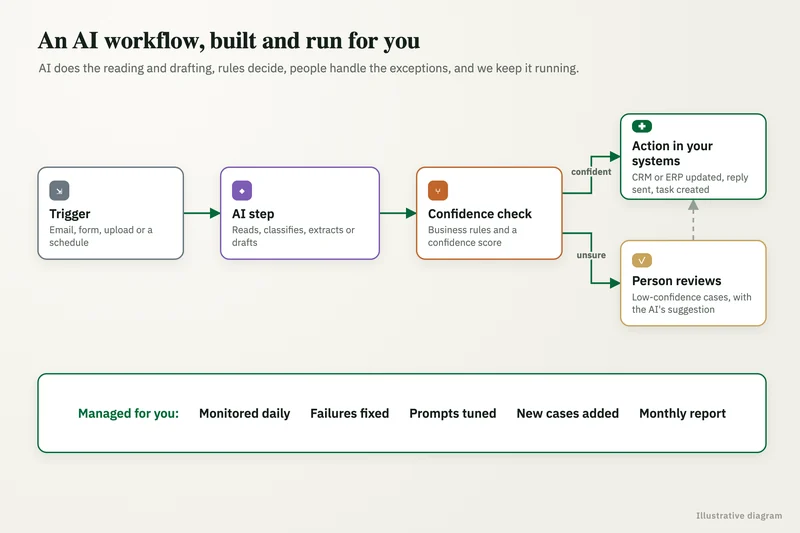
Most of our builds follow the same shape: a trigger, an AI step, a check, and a write-back. A new email in a shared inbox, a file dropped into SharePoint or a form submission starts the run. The model extracts, classifies or drafts. A rules layer validates the output, and the result is written to NetSuite, HubSpot, QuickBooks or wherever it belongs.
The check is what separates a production system from a demo. Each output carries a confidence score and passes format and business-rule validation (does the vendor exist, does the total match the line items, is the date in range). Anything below the threshold, or anything touching payments, customers or regulated data, goes to a human review queue in Slack, Teams or a simple AppSheet screen, where a person approves, edits or rejects it in a click.
How do you test an AI system before it goes live?
We test against your own history, not invented examples. Before launch we collect real past cases (often 50 to a few hundred, depending on variety), record the correct outcome for each and score the system against them.
Results are broken down by case type, so you see where the system is reliable and where it struggles. That tells us where to set confidence thresholds and which cases should always go to a person. The same eval set is rerun whenever a prompt, model or retrieval setting changes, which stops a fix for one problem from quietly creating another.
What does an AI implementation cost to run each month?
Running costs are usually model usage, platform fees and hosting, all billed by the vendors to your accounts. We estimate them in the scope using your real volumes, then set a cost cap per task so a stuck loop or an unusually long document cannot run up a bill.
Model usage scales with volume and document length, so we pick the cheapest model that passes the eval set for each step and reserve larger models for the hard cases. For build budgets and published market rates, our AI implementation cost guide covers the numbers in detail.
Why do AI implementations stall, and how do we prevent it?
They stall when the pilot never had a path into daily work. S&P Global Market Intelligence's 2025 survey reported that the average firm scrapped 46% of its proofs of concept before production, citing cost, data privacy and security.
We address each of those before writing code. Costs are estimated and capped. Data stays in accounts you control, and model vendors are used only on API or enterprise terms that fit your data rules. Security is handled with least-privilege service accounts, logged prompts and outputs, and an agreed list of what the AI may change. The review queue means the people who own the process trust the result before it runs on its own.
What happens after launch?
We stay on for a tuning period, then hand over or move to a support plan. During tuning we review every correction reviewers make, adjust prompts and thresholds, and track how much work now flows straight through.
One of our case studies shows the pattern: for a regulatory consulting firm we built a compliance management tool with recurring task generation, owners, due-date reminders and client-wise dashboards. Status reports now take under 15 minutes instead of 4-5 hours, saving the team 30+ hours a month. The handover pack for every build includes code, prompts, workflow exports, logs, the eval set and a runbook for common failures.
Case study · Insurance brokerage, Australia
Automation and dashboarding
Policy data arrived as spreadsheets from several insurers, each in a different structure, and every client report took hours of manual cleanup. An automated pipeline that standardizes every insurer's file and feeds a single reporting dashboard.
- Report time cut from 4-5 hours to under 5 minutes
- Reporting accuracy up from about 75% to 99%

How it works
How an engagement runs
- 01
Free review
We map the workflow, its volume, its systems and what a mistake costs.
- 02
Scope and price
You get the architecture, test plan and a fixed price in writing.
- 03
Build and evaluate
We build in your accounts and score the system against real past cases.
- 04
Supervised launch
Live traffic runs with reviewers approving outputs until accuracy is proven.
- 05
Tune and hand over
We lower the review load where it is safe, then hand over everything.
FAQ
Frequently asked questions
How long do AI implementation services take?
It depends on the number of systems involved and the state of the data. A single workflow with one integration is the fastest case, while builds touching several systems or voice channels take longer. The fixed scope we write after the free review includes a dated plan.
What are the steps to implement AI in a business process?
Define the inputs and outputs, get access to the systems, build the AI steps and integrations, test against real past cases, launch with human review, then tune. Skipping the testing or review steps is the most common reason pilots never reach daily use.
Do you only build with one AI vendor?
No. We test OpenAI, Claude, Gemini and open-weight models against your own cases and choose per step on accuracy, cost and data terms. The orchestration is built so the model can be swapped later without rebuilding the workflow.
Will the AI make changes in our systems without approval?
Only where you agree it can. Anything below the confidence threshold, and anything touching payments, customer communications or regulated data, waits in a review queue for a person to approve.
What do we need to provide for an AI implementation?
Access to the systems involved, a set of real past examples with the correct outcomes, and one person who owns the process and can answer questions quickly. That owner's time matters more to the timeline than anything else.
Who owns the finished system?
You do. It runs in your accounts with your API keys, and we hand over the code, prompts and documentation. There is no licence fee to keep using it.
Keep reading
Related pages
Get started
Tell us what you want automated
Describe the task, the systems involved and the volume. We reply within one business day with an architecture, the tools we would use, running costs and a fixed-price build plan.
- Free 30-minute build review
- Fixed quote before any work starts
- You own the accounts, code, prompts and data
Prefer email? info@aiimplementationconsultants.com
Get a free build plan
Two lines is enough to start.