

Data enrichment
Data enrichment services that fill the gaps in your CRM and product records
We provide data enrichment services that take thin records in HubSpot, Salesforce, a spreadsheet or a product database and fill in the missing fields from reliable sources, with every value traceable. It is for sales ops, marketing ops and data teams who are tired of routing, scoring and reporting on half-empty records.
Get a free build plan
Two lines is enough. A specialist replies within one business day.
Quick answer
What are data enrichment services?
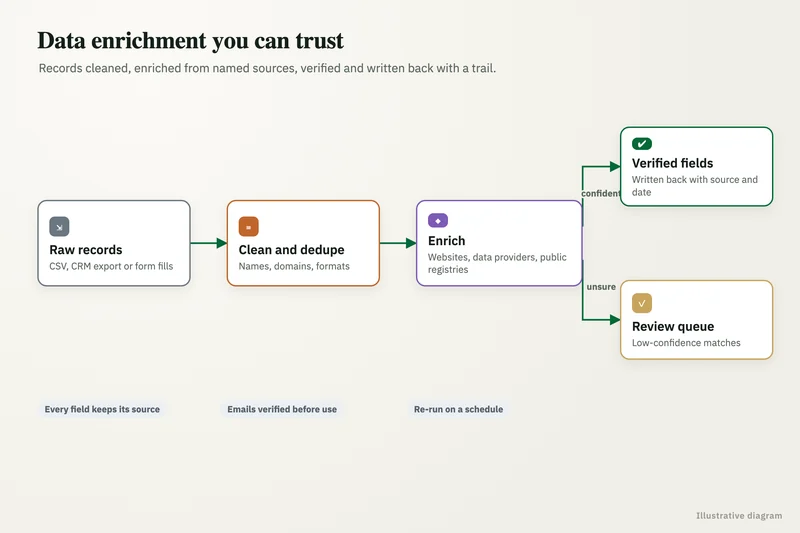
Data enrichment services add missing or outdated information to records you already hold, such as industry, employee count, location, website, job title or product attributes. Good enrichment pulls from several sources in order, records where each value came from, checks it against validation rules, and writes it back to your CRM or database on a schedule.
- Each enriched value stores its source and the date it was fetched.
- Sources run as a waterfall, so cheaper lookups go first and gaps fall through.
- Validation rules block bad values before they overwrite good ones.
- Enrichment runs on new records automatically and refreshes old ones on a schedule.
What do data enrichment services add to a record?
They add the fields your team needs to act on a record and that nobody had time to type in. For B2B companies that usually means firmographics on accounts and role details on contacts; for product and catalog teams it means specifications, categories and descriptions pulled from supplier sheets or manufacturer sites.
The fields are chosen by what they feed. If territory routing depends on state and employee count, those two fields come first. If lead scoring needs industry and tech stack, they do. We avoid enriching fields that nothing downstream reads, because each one costs money to fill and keep current.
- Accounts: domain, industry, employee band, headquarters location, LinkedIn page, parent company.
- Contacts: job title, seniority, department, verified work email where permitted.
- Products: dimensions, materials, compliance marks, category, cleaned descriptions.
- Custom: any fact visible on a company's own website, extracted by a language model with the page cited.
How does lead enrichment work inside HubSpot or Salesforce?
A trigger fires when a record is created or a key field changes, the enrichment workflow looks up the missing values, and the results write back through the CRM's API. In HubSpot that is typically a workflow webhook into n8n or a Python service; in Salesforce it can be a platform event or a scheduled job against a filtered list view.
Lead enrichment at form-fill time lets you keep forms short: ask for name and work email, then fill company size and industry behind the scenes before the lead reaches routing. We write enriched values into dedicated fields at first, so your team can compare them with what reps typed before anything is overwritten.
What you get
What we deliver
Scoped and quoted at a fixed price after a free review.
Field plan
A list of fields to enrich, what each one feeds, its sources in order and its validation rules.
Clean-up pass
Deduplication, normalization and merge batches reviewed by your team before enrichment starts.
Enrichment workflow
Triggers on new and changed records, a source waterfall and write-back to HubSpot, Salesforce or your database.
Provenance fields
Source and fetch date stored beside each enriched value so disputes and audits are easy.
Refresh schedule
Periodic re-checks of older records, prioritized by account value, inside a monthly cost cap.
Quality dashboard
Fill rate, accuracy samples, spend and records waiting for review, updated daily.
Which data sources and tools do you use?
We use prospect data platforms such as Clay and Apollo where they fit, alongside the client's own data, public company websites and language models that read those sites. The mix depends on your market, your budget per record and the terms each provider sets on reuse.
Sources are arranged as a waterfall: the cheapest reliable source runs first, and only records still missing a field move to the next one. Each value is stamped with its provider and fetch date, which matters when two sources disagree and when you need to show where personal data came from.
How do you keep enriched data accurate?
We validate before we write. Rules check formats (a real domain, a state code, a number in a sensible range), compare new values with existing ones, and refuse to overwrite a field a rep edited by hand unless you say otherwise.
When a language model extracts a fact from a website, it must quote the passage it used, and a confidence threshold decides whether the value posts or goes to a review list. We also measure fill rate and accuracy on a sample of records against a hand-checked set before go-live, then track both on a small dashboard so decay is visible month to month.
Can enrichment clean up duplicates and messy records too?
Yes, and it usually should come first. Enrichment works best on records that are already deduplicated and normalized, so most projects start with matching companies by domain, merging contact duplicates by email and standardizing values like country names and job titles.
That clean-up step often pays back on its own, because routing rules, reports and email sends stop double-counting. We run merges in review batches so a person approves anything ambiguous.
What about privacy rules for contact data?
Company facts are low risk; personal contact details need more care. We record the source of every contact field, respect each provider's terms on storage and reuse, and add a suppression list so people who opt out are never re-enriched or re-imported.
Access is limited by role inside the CRM, and enrichment logs keep who requested what and when. If you sell into regions with stricter privacy rules, we design the field plan with your counsel's guidance before any data is pulled.
What does ongoing enrichment cost?
Running cost is mostly per-record fees from data providers plus model calls for website extraction, so it scales with how many records you enrich and how often you refresh them. We set a cost cap per record and per month, and the waterfall order is tuned to keep expensive sources for records that matter, such as target accounts.
Our build is a fixed price agreed after a free review of a sample export. Provider subscriptions are billed to your accounts, so you keep them if we part ways.
How it works
How an engagement runs
- 01
Free review
You share a sample export and tell us what the data must drive, such as routing, scoring or reporting.
- 02
Field plan
We agree fields, sources, rules and a cost cap, then quote a fixed price.
- 03
Clean and test
We clean the sample, run enrichment on it and score fill rate and accuracy against hand-checked records.
- 04
Roll out
We switch on triggers for new records and backfill the rest in batches you approve.
- 05
Hand over
You get the accounts, workflows and dashboard, plus a short guide to adding fields later.
FAQ
Frequently asked questions
What is the difference between data enrichment and data cleansing?
Cleansing fixes what is already in your records: duplicates, bad formats, inconsistent values. Enrichment adds information that was never there, such as industry or employee count. Most projects need cleansing first so enrichment does not multiply the mess.
Is Clay or Apollo enough on its own?
Sometimes. Both are strong prospect data tools, but most CRMs also need deduplication, validation, write-back rules and refresh schedules around them. We build that layer and use those platforms as sources where they fit your market.
Can enrichment run automatically on new HubSpot contacts?
Yes. A HubSpot workflow can call an enrichment service when a contact is created, and the enriched fields write back within moments, usually before routing or scoring runs. Values below a confidence threshold go to a review list instead.
How often should CRM data be re-enriched?
It depends on how fast your market changes and how much each record is worth. Target accounts typically get more frequent refreshes than the long tail. We set a schedule by segment and cap monthly spend.
Can AI enrich product data, not just leads?
Yes. A language model can read supplier spec sheets or manufacturer pages and extract attributes like dimensions, materials and compliance marks into your product database, citing the source for each value.
Will enrichment overwrite what my reps entered?
Not unless you choose that. By default, enriched values go into separate fields or only fill blanks, and fields edited by hand are protected. You decide the overwrite rules per field.
Keep reading
Related pages
Get started
Tell us what you want automated
Describe the task, the systems involved and the volume. We reply within one business day with an architecture, the tools we would use, running costs and a fixed-price build plan.
- Free 30-minute build review
- Fixed quote before any work starts
- You own the accounts, code, prompts and data
Prefer email? info@aiimplementationconsultants.com
Get a free build plan
Two lines is enough to start.